

Question: I want to grow sunflowers. How can I grow them from seed? Which types grow best in Sonoma County?
Answer: Sunflowers are both cheerful to look at and easy to grow. They’re one of humanity's oldest crops and surprisingly varied. They can provide screening and shade, gorgeous cut flowers and nutrition-rich food. Pollinator insects, birds and kids love them.
Sunflowers (Helianthus) are named for the sun (in Greek, helio) because even before they bloom, sunflower buds turn to follow the sun’s path. Most of the more than 70 sunflower cultivars are native to North and Mesoamerica, so they do well here.
Sunflowers are so adaptable that they may help us understand and adapt to climate change.
For example, some sunflowers produce crops during drought without fertilizers, or in salty soil. In 2017, scientists sequenced and assembled the sunflower genome. If scientists can isolate these climate-resilient genes, many plants - and humans - could benefit.
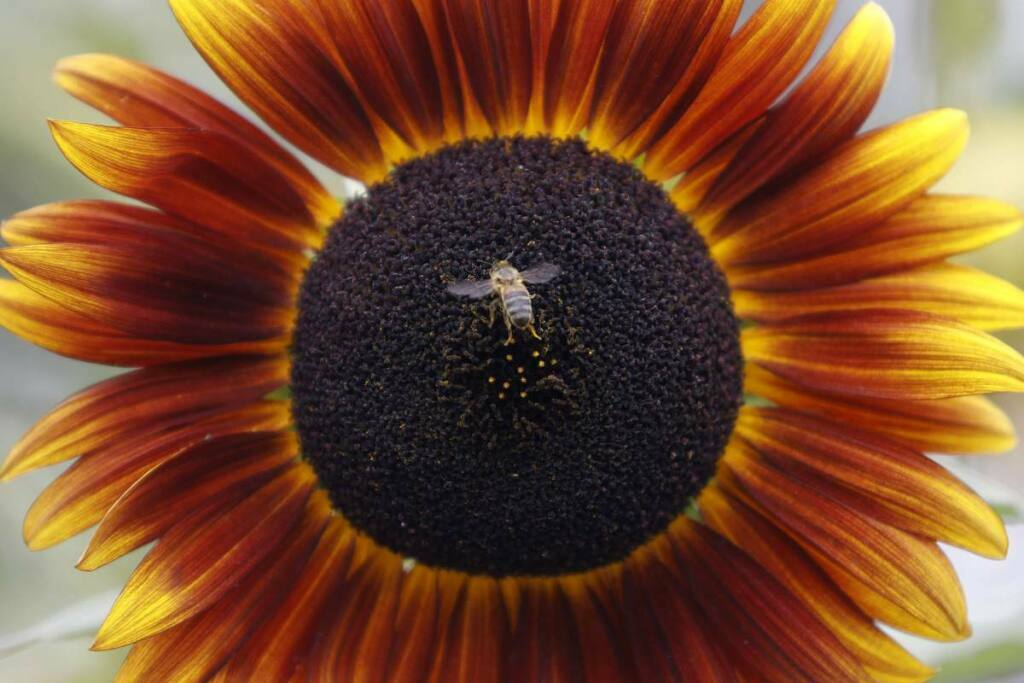
Most sunflower heads contain tiny florets arranged in a spiraling pattern known as the “Fibonacci sequence.” This recursive pattern in which each number is the sum of the two preceding ones, was named after Italian mathematician Fibonacci, also known as Leonardo Bonacci, who lived in the Middle Ages.
It occurs in most sunflowers, as well as in broccoli, daisies and seashells. However, according to a 2016 study, one in five sunflowers deviates from this pattern in fascinating, complex ways. (See link below.)
Tips for planting
Before planting seeds, first consider spacing. Annual sunflowers and perennials like to have room as well as six to eight hours of sun. Sunflowers may range from three to 15 feet tall, depending on the cultivar. Perennial sunflowers spread, so keep them bordered unless you want an abundance.
Single stem flowers need less space than the branching varieties that have several flowers per stem; plants with big flowers benefit from staking. You might dedicate an area to sunflowers for cut flowers and leave another more visible patch for display.
Seeds are widely available. Plant seeds in early spring, directly into the ground, leaving six inches between shorter varieties, and one to two feet between taller ones. Or plant clusters of three seeds and keep the strongest seedling. Top dress with compost and water regularly, but avoid nitrogen fertilizers. Keep sunflowers weeded and let them dry between watering. Then watch them grow, and bring on the pollinators!
Which ones to plant?
Choosing cultivars is fun. Sunflowers tend to hybridize with other cultivars so if you save seeds to plant, you’ll get some surprises!
Consider growing natives such as Helianthella californica, a California perennial. It grows about 2 feet tall, and its bright yellow flowers attract many beneficial insects. Natives are often drought and deer-resistant and tend to spread.
Helianthus gracilentus, or slender sunflower, is another native perennial with branching stems up to six feet tall and yellow blooms that hang around for months. A third native with a big wide bloom is ‘Delta Sunflower,’ Helianthus annuus, from the San Francisco Bay Delta.
If you have space, non-native perennial sunflowers are also generally resistant to drought and deer.
‘Showy’ sunflower, Helianthus laetiflorus, is a late-season cultivar which can reach eight feet tall and has long stems and yellow flowers. It can fill a space fast.
‘ Prairie’ sunflower, Helianthus maximilianii, from the Midwest, is another tall cultivar with many 4 inch golden flowers.
Helianthus salicifolius, the swaying ‘Willow Leaf’ sunflower, grows 6 feet tall with bright blooms and dark centers. It has drooping, willowy leaves that make an appealing vertical show.
Annuals also offer many color combinations. The ‘Lemon Queen’ cultivar is beloved by pollinators, and recommended by The Great Sunflower Project, a citizen science undertaking to help prevent pesticide-related colony collapse among bees.
‘Pastiche’ is a branching, beautiful sunflower with reds, yellows and buffs that make for a good summer screen, growing four to five feet tall. ‘Moonwalker’ has a yellow face with a chocolate center. ‘ Russian Giant’ is a spectacular 10 foot high plant with yellow flowers that have a dark center.
Some bird lovers experiment with simply planting black oil sunflower seeds purchased as bird feed. They often grow where dropped.
For cut flowers, choose smaller sunflowers that won’t tip your vase. Plant every two weeks for an ongoing supply. Cut the flowers when three “ray” petals have opened; let the rest open inside so they last longer.
Finally, consider the sunchoke, aka ‘ Jerusalem artichoke,’ Helianthus tuberosis. This edible tuber has probiotic benefits because it is high in insulin. Plant four to five tubers for a good winter crop. But these are famously invasive, so consider using a large container. Then enjoy their tall flowers and delicious tubers.
The UC Master Gardener Program of Sonoma County at sonomamgucanr.edu, provides environmentally sustainable, science-based horticultural information to Sonoma County home gardeners. Send your gardening questions toscmgpd@gmail.com.